
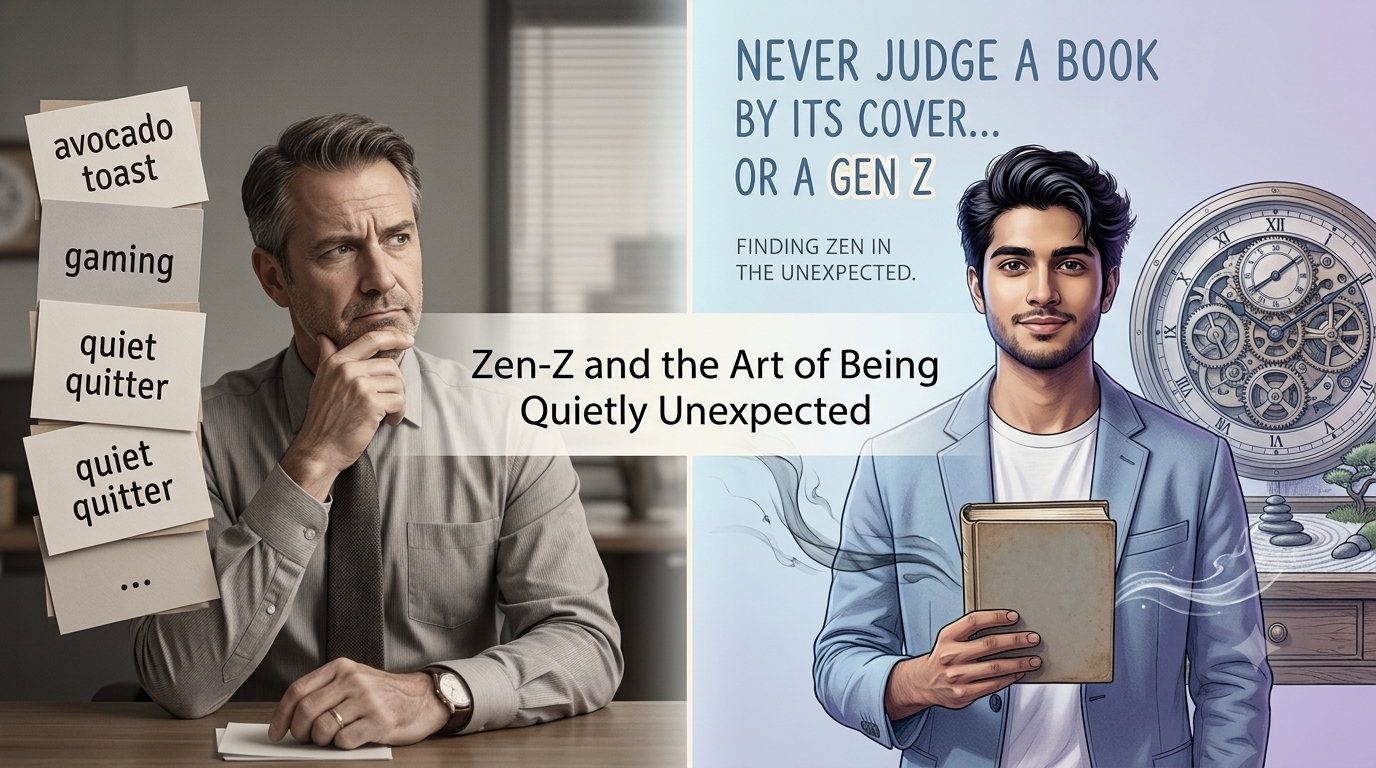

An unexpected office encounter, a Gen Z stereotype, Kabir’s wisdom and five small lessons about why first impressions can be dangerously wrong.
“Never judge a book by its cover. And perhaps never underestimate a Gen Z either. He may surprise your entire generation.”
There are people in every office whom we understand immediately.
Or at least, we think we do.
There is the colleague who speaks before thinking. The colleague who thinks before speaking and then decides not to speak at all. The one who knows where every missing file is. And, of course, the one who disappears whenever actual work begins.
Then there was this young man.
My first impression of him was simple.
Secretive.
Not criminal-secretive. Nothing so exciting. But he had that quiet look—the kind of person who seemed to observe strangers before deciding whether they were worth observing further.
He usually wore a full-sleeved shirt. His hair had a slightly rebellious relationship with the comb, and his beard appeared to have been given complete freedom under a democratic constitution.
When there was work, he worked.
When there wasn’t, he could sit quietly inside his cabin for a long time, often engaged with his mobile phone and some Japanese game whose rules I neither understood nor had the courage to ask about.
So naturally, like many human beings blessed with very little information and a great deal of confidence, I formed an opinion.
I had him figured out.
Then I discovered that he belonged to Gen Z.
And that, unfortunately, gave my imagination even more material to work with.
When a Label Walks Into Your Head Before a Person Does
By then, the internet had already done a reasonably good job of explaining Gen Z to the rest of us.
Or so it claimed.
Young. Fearless. Stubborn. Permanently attached to the phone. Quick to protest. Quick to question. Occasionally accused of being too distracted to survive without Wi-Fi.
Recent media conversations and the endless noise around young people’s protests had added their own colours to the picture.
And there he was, sitting quietly in an office cabin, occasionally looking at his phone.
My brain was delighted.
Case closed.
Except human beings are very inconvenient creatures.
They rarely remain inside the categories we create for them.
And this young man, without making any effort whatsoever, slowly began to ruin my theory.
The First Surprise: He Took His Work Seriously
I began noticing something.
He worked hard.
Not with the dramatic sighing and keyboard-pounding usually associated with making sure everyone knows that you are working hard.
He simply worked.
There was sincerity in the way he approached his responsibilities. At times, he spoke about work with a seriousness that reminded me of something deeper than ambition.
To him, work seemed to carry a certain dignity.
Almost as if doing one’s duty properly was, in its own quiet way, an offering.
And somewhere during our conversations, Lord Rama entered the office.
Not literally, of course. That would have made the HR department considerably more interesting.
I discovered that this apparently secretive Gen Z colleague had a genuine interest in the Sundarkand.
He did not merely know a few familiar lines.
He read it.
He interpreted it.
And when he explained certain parts, there was an honesty in his interest that made me listen more carefully.
I had expected a young man absorbed entirely by a screen.
Instead, I found someone who could move comfortably between a Japanese mobile game and the world of Hanuman, devotion, duty and courage.
That was the first crack in my first impression.
More were coming.
The Second Surprise: Kabir Was Also Sitting in the Cabin
He liked Kabir’s dohas.
He listened to them.
He recited them.
Sometimes the youngest-looking person in the room carries the oldest questions.
That thought stayed with me.
Here was a young man who belonged to a generation we often associate with speed, scrolling and short attention spans. Yet he could sit with old words, old stories and old wisdom.
Perhaps I had been asking the wrong question.
Instead of asking:
“What are Gen Z people like?”
Maybe I should have asked:
“What is this particular person like?”
There is a considerable difference between the two.
The first question gives us a stereotype.
The second gives us a human being.
Perhaps He Was Never Secretive
This is the embarrassing part of the story.
He had not changed.
I had.
The full-sleeved shirts were still there.
The slightly shabby hair remained faithful to its personality.
The beard survived.
The Japanese games continued.
He was still quiet.
Still Gen Z.
Still himself.
The only thing that had changed was my ability to see beyond the first few details.
And perhaps that is the real danger of first impressions.
They often begin as observations but quickly become conclusions.
Someone is quiet, and we call them arrogant.
Someone uses a phone often, and we call them distracted.
Someone is young, and we assume they lack depth.
Someone is older, and we assume they possess wisdom.
Sometimes we are right.
But often, we have simply written the first chapter and decided there is no need to read the rest of the book.
This reminded me of something I explored in my earlier article, The Invisible Stress You Didn’t Know You Were Carrying. People often carry invisible stress, emotions and private struggles that do not show up in their behaviour at first glance.
Perhaps personality is invisible in the same way.
You see the phone.
But not the discipline.
You see the silence.
But not the observation.
You see the beard and the untidy hair.
But not Kabir quietly sitting somewhere inside the person.
The Unexpected Lesson in Mindfulness
I did not learn this lesson in a monastery.
I learned it in an office.
Between work, conversations, a mobile game and a discussion about the Sundarkand.
Perhaps mindfulness is not always about sitting cross-legged and trying to negotiate with your thoughts.
Sometimes it begins with simply paying better attention to the person sitting across from you.
The American Psychological Association’s guidance on mindfulness discusses the value of paying attention to present experience without rushing into automatic judgment or reaction.
That idea feels surprisingly useful outside meditation.
Imagine using it in ordinary life.
Before deciding that someone is difficult, pause.
Before assuming a generation thinks exactly one way, pause.
Before judging a colleague from their appearance, pause.
You may not become enlightened.
But you may save yourself from being confidently wrong.
5 Easy Life Hacks I Learned From One Unexpected Colleague
1. Give people three conversations before giving them a label
A first impression is only the trailer.
Don’t write the entire review before the film has begun.
Talk to the person. Listen to them. Observe them in different situations.
Human beings deserve at least a few conversations before being permanently assigned a personality by your imagination.
2. Separate appearance from character
A beard is facial hair.
A phone is a device.
Silence is silence.
None of these things can independently explain the complexity of a human being.
Next time you catch yourself making a quick judgment, ask:
“What do I actually know, and what have I simply assumed?”
3. Be curious about people who don’t fit your expectations
The people who confuse us are often the people who teach us something.
If someone does not fit your mental category, don’t immediately try to force them into another one.
Stay curious.
Curiosity is far more useful than premature certainty.
4. Keep one piece of old wisdom in your modern life
I liked the contrast.
A young man can enjoy Japanese games and Kabir.
He can live with a smartphone and still find meaning in the Sundarkand.
Perhaps modern life does not require us to throw away everything old.
Maybe we simply need to carry forward what still gives us strength.
A prayer.
A poem.
A doha.
A book.
A morning walk.
Five quiet minutes.
In fact, if your own digital life feels increasingly noisy, you may also find something useful in my earlier guide, 20-Minute Digital Detox: The Ultimate Bedtime Wind-Down.
5. Allow reality to update your opinion
This may be the most important lesson.
Changing your mind does not always mean you were weak.
Sometimes it means you finally received enough information.
A good mind is not a mind that never changes.
It is a mind that knows when to say:
“I thought I understood. But I was wrong.”
The Man Didn’t Change. My Eyes Did.
I still see the same young colleague.
Quiet.
Full-sleeved shirt.
Shabby hair.
Beard.
Mobile games.
Gen Z.
But now the picture is larger.
I also see sincerity.
A respect for work.
An interest in the Sundarkand.
Kabir’s dohas.
A personality that refuses to fit neatly inside the little box I had prepared for it.
And perhaps that is the small miracle hidden in ordinary human encounters.
Sometimes, another person does not deliberately teach you anything.
They simply live honestly enough to expose the mistake in your assumptions.
That, for me, was the real lesson.
We often think we are meeting people.
But sometimes we are only meeting our own prejudices first.
The actual person arrives later.
Usually quietly.
Sometimes wearing a full-sleeved shirt.
Sometimes with a slightly untidy beard.
Sometimes carrying Kabir in his memory and a Japanese game on his phone.
And sometimes, without even trying, reminding us of one simple truth:
Don’t judge a book by its cover.
Because occasionally, when you finally open it, you may discover a story you never expected to find.
“`

Please Leave a Reply