

“I like all and dislike none. I fear nobody, except the higher Self within me — the one I remember by different names, mostly when I am under crisis.”
Perhaps this is an unusual way to begin a September morning.
But lately I have been wondering about something.
Why are we so often dissatisfied with the person looking back at us from the mirror?
Ageing.
Anti-ageing.
Tanning.
Non-tanning.
Brightening.
Correction.
Protection.
One product appears, then another. One small imperfection becomes visible, and suddenly there is a solution waiting on a shelf somewhere.
I am not saying that caring for your skin is wrong. It isn’t.
Sun protection matters. Dermatologists recognise that ultraviolet exposure can contribute to premature skin ageing and skin damage, and the American Academy of Dermatology recommends sensible protection from the sun. You can read their practical guidance on reducing premature skin ageing.
There is a difference, however, between caring for yourself and becoming afraid of yourself.
And somewhere between those two things, I think we have lost something.
The face we keep trying to correct
Imagine someone standing before the mirror after a long day.
There is no dramatic music.
No great tragedy.
Just a tired person looking closely at their own face.
They notice a new line near the eye.
They touch it.
For a few seconds, they don’t say anything.
Then comes the thought:
“I am getting old.”
And somehow those four words become much heavier than they should.
That little line was only a line.
But the mind turned it into a verdict.
This is where I sometimes wonder whether the beauty industry has understood something about human beings that we ourselves have forgotten.
It doesn’t always have to tell us that we are ugly.
It only has to make us feel that we are not quite enough yet.
A little younger.
A little smoother.
A little brighter.
A little less tanned.
A little more like the picture on the screen.
And tomorrow, perhaps, there will be another thing to correct.
This is how scarcity can enter the mind.
There is never quite enough beauty.
Never quite enough youth.
Never quite enough approval.
Never quite enough perfection.
The danger is not the cream.
The danger is when we begin believing that we need the cream in order to be acceptable.
Then care becomes dependence.
And dependence quietly becomes worry.
But beneath all that coating, beneath the mask we keep improving, there may be something else waiting.
A quieter person.
A more ordinary person.
A more human person.
Almost whispering:
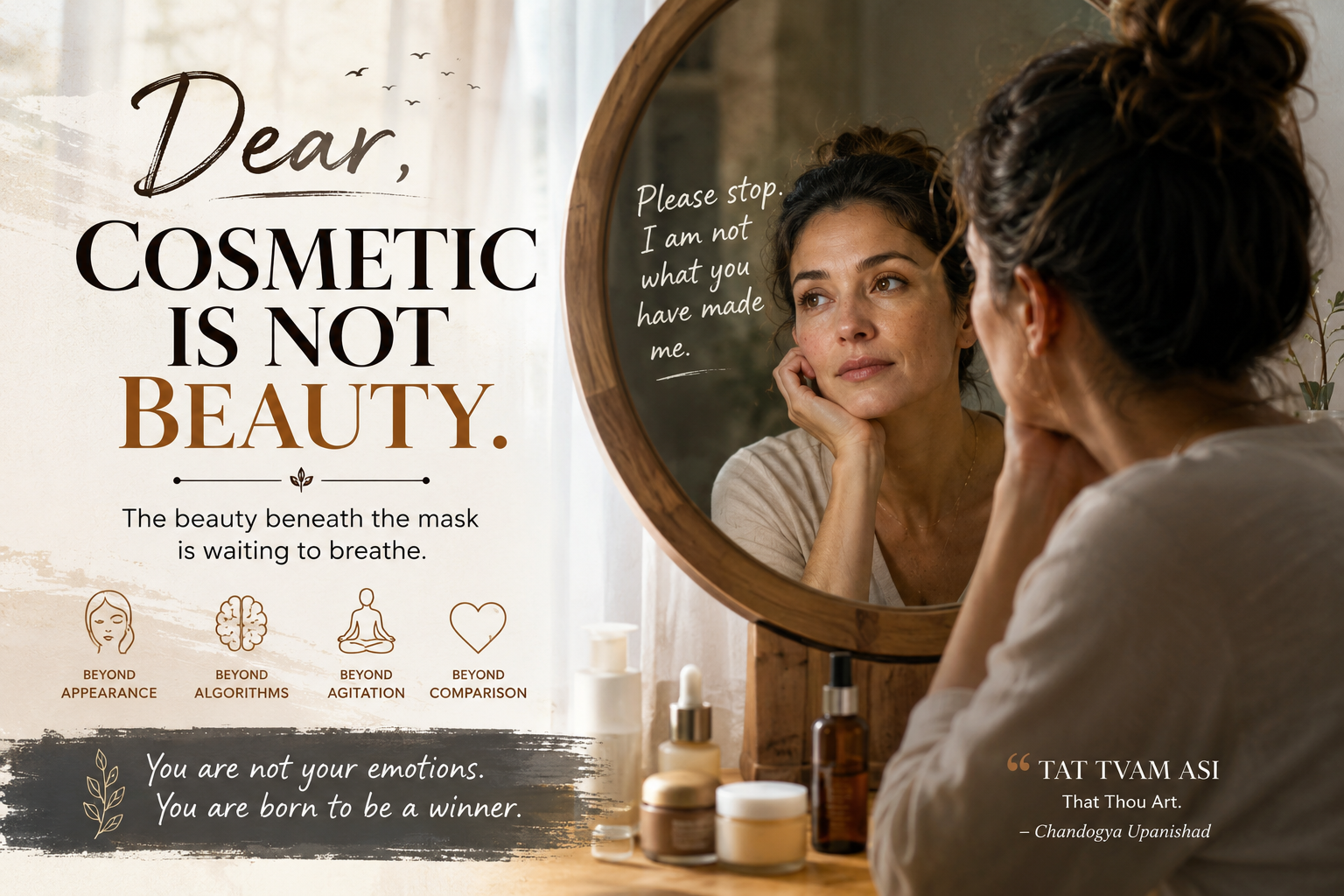
“Please stop. I am not what you have made me.”
Have you ever thought about this?
What makes you so much always in agitation?
Sometimes I think our restlessness is not caused only by what is happening around us.
Sometimes it comes from what we have stopped hearing within us.
We wake up and reach for the phone.
We look at messages.
We check the world before checking ourselves.
Then the day begins.
Work.
Traffic.
News.
Videos.
Opinions.
Advertisements.
Other people’s lives.
By evening, we have seen hundreds of things.
But how much time have we spent seeing ourselves?
There is a higher end of us — a deeper part that seems to remain quietly asleep.
You may call it conscience.
You may call it awareness.
You may call it the higher Self.
Someone else may give it another name.
The name is not important to me.
The listening is.
And perhaps we are afraid to wake that part of ourselves.
Because what if it shows us our real picture?
WHAT IF THE REAL PICTURE IS NOT THE FACE WE HAVE BEEN TRYING TO BUILD, BUT THE PERSON WE HAVE BEEN AVOIDING?
That question is uncomfortable.
It is easier to correct the skin than to question the insecurity.
Easier to buy another product than to ask why one photograph can ruin our entire evening.
Easier to scroll than to sit quietly with ourselves.
But perhaps that quiet sitting is where something important begins.
I have written about this same inward journey from another door in The Superpower I’d Choose —And Why It Would Break Me — the strange possibility that the greatest power we could possess might not be flight, strength or invisibility, but the courage to truly know ourselves.
Perhaps that is where our real work begins.
The phone became smart. And human beings?
WordPress reminds me to write.
Sometimes the question is simple.
Sometimes it seems to say, “If you don’t know what to write, here is another question. Try this. Think about that.”
And I understand the logic.
Questions can be useful.
A good question can open a locked room inside the mind.
But there is another side to this modern world.
Social platforms learn from us.
They notice what makes us stop scrolling.
What we watch.
What we share.
What makes us angry.
What makes us curious.
What keeps our eyes on the screen for another minute.
They learn our behaviour.
And increasingly, machines are being trained using enormous amounts of human-generated information.
Look at the irony.
Others can use our collective human intelligence to build systems that become increasingly capable.
And what do many of us do with our own intelligence?
We scroll trending videos.
We make a share.
We react.
We move on.
Then another video arrives.
And another.
And another.
I have explored this feeling before in Algorithmic Fatigue in 2026: Healing Digital Burnout from Within — that strange exhaustion of being connected everywhere while becoming increasingly absent from ourselves.
But perhaps there is an even deeper question.
ARE WE BUILDING MACHINES THAT LEARN WHILE FORGETTING HOW TO LEARN OURSELVES?
There is a statement I have seen many times:
“Artificial intelligence will prove to be a milestone for human beings.”
— Anonymous
Perhaps it will.
I hope it does good.
But then I look around and another question quietly comes.
Students are still repeatedly failing examinations.
Information has never been easier to access.
Phones have become incredibly smart.
Machines can calculate, translate, generate, predict and remember.
And the human being holding the phone sometimes struggles to sit quietly for ten minutes.
So why was this intelligence born?
Only so that machines could become smarter?
Only so that companies could understand us better?
Only so that algorithms could keep us watching?
Or was human intelligence also given to us so that we could understand the person who is using it?
Because something seems strangely uncommon these days.
COMMON SENSE.
It seems to be becoming very uncommon.
Not because human beings are stupid.
Perhaps because our intelligence is constantly being distracted.
We know how to consume information.
But do we know how to question it?
We know how to share opinions.
But do we know how to sit with uncertainty?
We know how to make machines learn.
But do we still know how to learn from our own mistakes?
You are not a slave of your emotions
There is one thing I want to remind myself before reminding anyone else.
You are not your anger.
You are not your fear.
You are not your jealousy.
You are not your sadness.
You are not every thought that passes through your mind.
You can observe these things.
And perhaps the person who can observe a thought is not completely trapped inside it.
There is a little space.
And inside that little space, choice begins.
I like all and dislike none.
I fear nobody.
Except the higher Self.
Not because I think of it as something frightening.
But because it has a strange habit of making excuses uncomfortable.
When everything is going well, I sometimes forget it.
When life becomes difficult, I remember.
God.
Prayer.
Silence.
My own conscience.
Why do we often remember the deepest things only when we are under crisis?
Perhaps crisis removes the decoration.
It makes us look at what remains.
And that is why I don’t want to tell anyone to throw away cosmetics.
Use them if you enjoy them.
Care for your skin.
Protect yourself from the sun.
Dress beautifully.
Use technology.
Enjoy modern life.
There is nothing wrong with these things.
Just don’t hand your identity over to them.
Your face is not your worth.
Your age is not your failure.
Your skin tone is not your character.
Your followers are not your intelligence.
Your failures are not the final definition of you.
And your emotions are not your master.
You were not born merely to react.
You were born with the ability to see.
Tatva — TAT TVAM ASI
There is an old story I keep returning to.
In the sixth chapter of the Chandogya Upanishad, a father named Uddalaka Aruni speaks with his son Shvetaketu.
Shvetaketu has spent years studying.
He has learned many things.
And when he returns home, there is a certain confidence in him — the confidence of someone who believes that knowing many things means knowing what truly matters.
His father does something beautiful.
He does not simply give his son more information.
He takes him deeper.
Through simple examples and questions, he begins moving from what can be seen toward what cannot easily be seen — from the outer form toward the subtle essence behind it.
And again and again, the teaching arrives at those famous words:
TAT TVAM ASI.
That Thou Art.
It is a profound teaching, and different Indian philosophical traditions have understood it in different ways. I would not want to reduce it to a fashionable sentence printed on a wall.
But sitting with it quietly, I find a question.
What if we have spent too much of our life searching outside?
What if we keep polishing the surface while forgetting the one who is looking through the eyes?
What if beneath ageing, tanning, anti-ageing, cosmetics, algorithms, phones, success, failure, fear and ambition — there remains something we have not properly met?
Something that does not need to be brightened.
Something that does not need to be made younger.
Something that does not need an algorithm to approve it.
Something that does not become more valuable because somebody presses a button.
Maybe the beauty we keep trying to manufacture is not the beauty we were actually looking for.
Maybe it was never outside.
Maybe it has been quietly waiting beneath all the noise.
Waiting beneath the mask.
Waiting beneath the comparison.
Waiting beneath the endless desire to become somebody else.
And perhaps that is why an old question still feels strangely alive.
Who are you?
Not your photograph.
Not your age.
Not your profession.
Not your profile.
Not your success.
Not your failure.
Not even the story you have been telling yourself for years.
Who are you when all those things become quiet?
Maybe that is the question we keep avoiding.
And perhaps the answer is closer than we think.
May God save mankind.
Because perhaps before we ask what artificial intelligence will become, we should ask what human intelligence was meant to become.
And there is one more question hidden behind all of this…
What happens when the human being finally stops running from the person in the mirror?
Perhaps that is where the real story begins.
Please Leave a Reply