
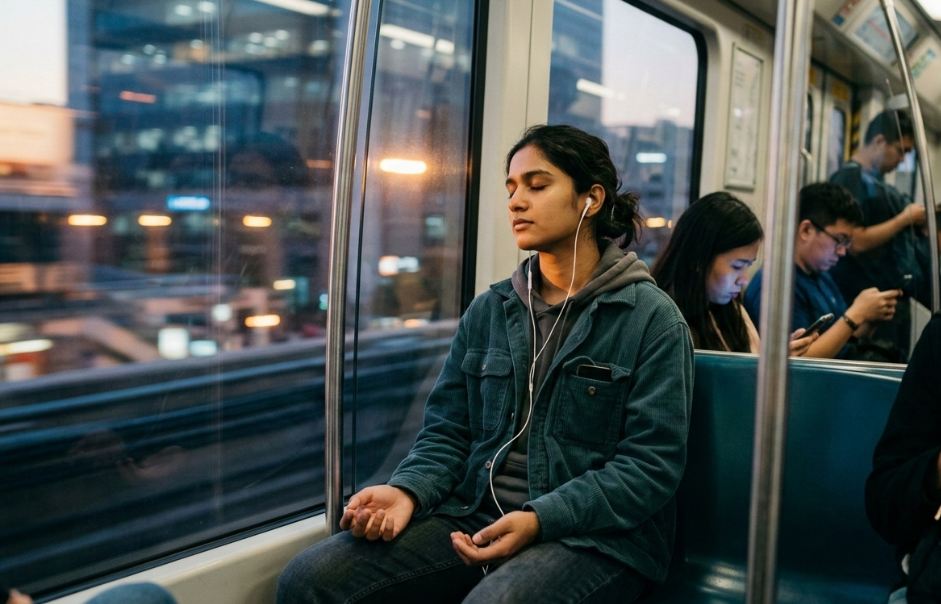

(No Upsells, No Paywalls)
Most mindfulness apps want your credit card within three days.
This post is for the readers who find that more stressful than helpful.
Let me be honest with you before we begin: the app economy has done
something peculiar to mindfulness. A practice that emerged from Buddhist
monasteries, from Stoic philosophers, from the simple and ancient act of
paying attention — it now arrives on your phone wrapped in a 7-day free
trial, a gentle reminder that your calm is about to expire, and a yearly
subscription that costs more than a therapist’s first session in some
cities.
This post is not about those apps.
This is for readers in Bengaluru, in Belfast, in Cebu, in Cape Town — for
anyone who wants to begin a mindfulness practice without first handing over
a bank card and holding their breath through a cancellation window. These
apps are genuinely free. Some have optional paid tiers. I will tell you
exactly which is which, so you can decide with clear eyes.
But first — a word about what we are actually looking for.
What Makes a Mindfulness App Actually Work?
There is a reason the mindfulness app market has ballooned to billions of
dollars while collective urban anxiety has gone in exactly the same direction.
Downloading an app and using an app are two very different things. And using
it once after a hard Tuesday is not the same as building something that lasts.
The research is clear on what matters — and it is not the app itself.

A 2024 study highlighted by Harvard Health Publishing
enrolled 1,247 adults across 91 countries — most with no prior mindfulness
experience — and found that just 10 minutes of daily practice delivered
through a free mobile app reduced depression symptoms by nearly 20%,
decreased anxiety, and increased motivation toward healthier habits including
better sleep and regular movement. Participants highlighted greater awareness,
self-control, gratitude, patience, and a genuine sense of joy in the moment.
Ten minutes. Free app. 91 countries. Nearly 20% fewer depression symptoms in
one month.
The variable that determined outcomes was not which app. It was consistency.
And consistency, in a crowded commuter city, requires something low-friction,
low-cost, and — ideally — low-guilt.
That is exactly what we are building toward here.
“The goal is not to find the perfect app.
The goal is to find the one you will actually open again tomorrow.”
The Honest Free App Guide (No Trial Traps)
What follows is not a ranking. It is a field guide — five genuinely free
options, each suited to a different kind of city reader, with complete
transparency about what is free and what is not.
1. Insight Timer — The Biggest Free Library on the Planet
Free content: Over 80,000 guided meditations from 10,000+
teachers. No credit card. No expiry. No paywall on the core library.
What costs money: Insight Timer Plus adds courses and offline
downloads. The free version works entirely online.
Best for: Anyone who wants variety without commitment — the
reader who cannot decide, who wants to browse, who has fifteen minutes and no
idea where to begin.
Insight Timer is genuinely unusual in this market. Most apps funnel you toward
a subscription within days. This one has built a global community of meditators
and kept the core library free by design. The home screen shows a real-time
world map of people meditating right now — in Mumbai, in Manila, in Manchester,
all present at the same moment. For a city person who sometimes feels very alone
in their exhaustion, that small detail matters more than it should.
Download: Available on iOS and Android. No website registration
required to get started. Search: Insight Timer.
2. Smiling Mind — Built by Psychologists, Entirely Free
Free content: Everything. All programmes. No premium tier.
No upsell. Ever.
What costs money: Nothing. This is a registered non-profit.
Best for: The absolute beginner. The reader who tried meditation
once and found it strange. The parent who wants to start a family practice. The
commuter who has exactly seven minutes.
Smiling Mind was created by Australian psychologists and educators who wanted to
make mindfulness genuinely accessible — which meant not charging for it. The app
runs structured programmes (Mindful Foundations, Stress Management, Sleep, Digital
Detox) with sessions mostly between five and fifteen minutes. Everything is
evidence-based. Nothing is monetised. It has been downloaded by over 5.5 million
people.
I find it the most honest app in this space. It has no business model built on
anxiety about what you might miss if you do not upgrade. It simply exists to help.
Download: iOS and Android. Also available at
smilingmind.com.au
with a browser-based version for readers who prefer not to install an app.
3. Healthy Minds Program — The Science-First Option
Free content: The entire programme. Permanently free.
What costs money: Nothing.
Best for: The reader who wants to understand why
mindfulness works before they trust it. The sceptic. The person who read
the Harvard study and wants the thinking behind the practice, not just the
practice.
The Healthy Minds Program was built by the Center for Healthy Minds at the
University of Wisconsin-Madison — the research institution behind some of the
most cited neuroscience on mindfulness and the brain. The app delivers
podcast-style audio lessons for both seated and active practice, tied to
the underlying science of awareness, connection, insight, and purpose.
It does not feel like a wellness product. It feels like sitting with a
researcher who genuinely wants you to understand what you are doing and why
it works. For the city reader who intellectually resists anything that feels
like a trend — this is the entry point that finally makes it stick.
Download: iOS and Android. Search:
Healthy Minds Program by Healthy Minds Innovations.
4. UCLA Mindful — No App Required
Free content: Everything. Audio files downloadable directly
from the UCLA Health website.
What costs money: Nothing.
Best for: Readers with limited data or device storage. Anyone
who wants to download once and use offline, in any corner of the world.
UCLA Health’s Mindful Awareness Research Center publishes free guided
mindfulness meditations in English and Spanish — downloadable audio files in
5-minute and 20-minute versions. No account. No registration. No algorithm
deciding what you see next.
For readers in areas with unreliable internet — or for anyone who finds the
app ecosystem itself overstimulating — this is a clean, quiet alternative.
You download the file. You sit with it. That is the entirety of the process.
Access:
Free guided meditations at UCLA Health
.
The app (UCLA Mindful) is also available on iOS and Android at no cost.
5. Mindfulness Coach — Made by the US Department of Veterans Affairs
Free content: Everything.
What costs money: Nothing.
Best for: Readers dealing with stress that goes beyond the
ordinary. Anxiety that is structural, not situational. Anyone who wants a
practice with clinical roots rather than wellness branding.
This app was developed by the National Center for PTSD at the US Department
of Veterans Affairs. It was built for veterans and service members, but it is
publicly available and relevant to anyone managing significant stress. It mixes
guided sessions with education on the benefits of mindfulness, concentration
tools, goal tracking, and links to additional resources — all at no cost.
It is less polished than the commercial options. The design is functional rather
than beautiful. But if what you need is something built with clinical rigour for
people carrying real weight — not people curating a wellness aesthetic — this is it.
Download:
VA Mobile Health App Directory
.
iOS and Android. Search: Mindfulness Coach VA.
A Word on the Apps You Have Already Heard Of

Headspace and Calm are not in this guide. That is not a judgement on either.
Both are genuinely well-made.
Harvard Health’s review of the most popular mindfulness apps
notes that Headspace is among the few commercially available apps that has been
experimentally studied, showing decreased depression and increased positive
emotions after 10 days of use. That is a real result, from real research.
But both require a subscription after their trials — Calm and Headspace at
roughly similar annual pricing — and this post is specifically for the reader
who is not there yet. Who wants to know if mindfulness is worth their time
before deciding it is worth their money. That is a fair starting point.
The apps above serve it honestly.
When you are ready to invest — when you find yourself returning daily for
several weeks and wanting more depth — that is the right moment to consider
a paid option. Not because a free trial is expiring. Because you have
decided it matters.
How to Actually Use a Mindfulness App (So It Sticks)
The app is not the practice. The app is the invitation. And like most
invitations, accepting it once and then losing the details is not the same
as showing up.
Research from Harvard Health
shows improvement in attention, memory, mood, and emotional regulation after
just eight weeks of short daily mindfulness sessions. Eight weeks. That is the
realistic timeline for change you can actually feel — not the silent retreat
version, but the seven-minutes-before-your-commute version. The type that
city people can actually sustain.
Three things make the difference, drawn from what the research shows rather
than what the apps tell you.
The first is placement. The apps that get used are tied to an existing habit
— morning tea, the first three minutes after sitting down at a desk, the walk
between the train station and the office. The brain does not build new habits
from scratch; it attaches new behaviours to existing anchors. Find your anchor
before you open the app for the first time.
The second is permission to be inconsistent. Most people abandon a mindfulness
practice because they miss three days and feel they have broken something. You
have not broken anything. The research does not require a perfect streak.
It requires returning. That is the only thing.
The third is keeping sessions short. Five minutes of genuine presence is worth
more than twenty minutes of distracted endurance. Begin with five. Stay at five
for a week. Add two minutes when it feels easy. The nervous system does not need
duration — it needs regularity.
If you have been struggling with screen time — finding that the phone you are
meant to meditate with is the same phone you cannot stop scrolling — the
Digital Detox Before Bed guide
is worth reading alongside this one. The two practices complement each other:
the evening detox creates the mental space that morning mindfulness can then
actually fill.
When a Free App Is Enough — And When It Might Not Be
This post is honest about apps. It should be equally honest about their limits.
Mindfulness apps — free or paid — work well for managing the ordinary texture
of urban stress: the ambient anxiety of a full inbox, the fatigue of a week of
directed attention, the low-level overstimulation that is simply the weather of
city life. They work as a daily regulation tool. As a way of practising return
— returning to the breath, to the body, to this moment.
They are not a substitute for professional support when what you are carrying
is heavier than that. If you have tried several of the options above and find
that nothing shifts — if the practice feels unreachable rather than simply
unfamiliar — that is information worth listening to. Your GP, a counsellor,
or a trusted person in your life is the next conversation, not a different app.
That distinction is one the wellness app industry has very little interest in
making for you. So we make it here, plainly, before we go.
There is a difference between needing quiet and needing help. If you have been
sitting with something that does not quite resolve with rest alone,
The Inner Wilderness — on mindfulness and self-awareness
explores that threshold more carefully than most wellness writing allows itself to.
And if part of what you are building is a wider system — not just a meditation
practice but a way of organising your week so that rest and attention are built
in rather than bolted on —
Systems Over Motivation
is the frame that makes everything else sustainable.
One more thread to pull: if you read
What Happens to Your Brain When You Do Nothing on a Sunday?
— the previous post in this series — you already know what the brain does when
it is finally given space. A mindfulness app is one way to create that space
intentionally, on the days when Sunday stillness is not available. Think of it
as a scheduled window for the work your brain has been trying to do all week.
Frequently Asked Questions
Which mindfulness app is completely free with no subscription?
Insight Timer is the most genuinely free option — over 80,000 guided
meditations at no cost, no credit card required. Smiling Mind (non-profit)
and the Healthy Minds Program from the University of Wisconsin-Madison are
also fully free with no premium tier whatsoever.
Do free mindfulness apps actually work?
Yes. A 2024 study cited by Harvard Health found that 10 minutes of daily
mindfulness delivered through a free mobile app reduced depression symptoms
by nearly 20% across 1,247 participants in 91 countries. The tool matters
far less than the consistency of returning to it.
How long does it take for a mindfulness app to make a difference?
Harvard Health research points to measurable improvements in attention,
memory, mood, and emotional regulation after approximately eight weeks of
short daily sessions. Some studies show early benefits within 10 days.
The key is returning — not maintaining perfect streaks.
I have never meditated before. Which free app should I start with?
Smiling Mind is the most beginner-friendly — built by psychologists,
structured into clear programmes, and entirely free. For more variety from
day one, Insight Timer’s beginner collections are well-curated and require
no account to browse.
Can I use a mindfulness app on a slow or limited data connection?
Insight Timer and Smiling Mind both allow offline downloads once you have
a free account. UCLA Mindful’s audio files can be downloaded directly from
the UCLA Health website for offline use — no app, no data, no connectivity
required after the initial download. This matters for readers in areas with
unreliable internet access.
Urban Mental Health & Wellbeing


Please Leave a Reply