
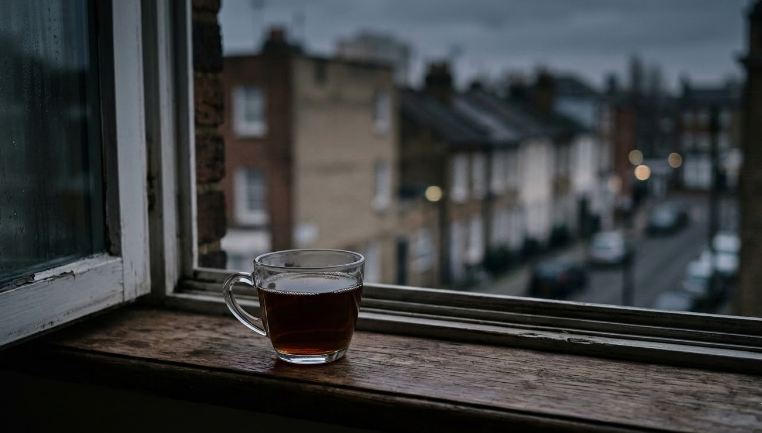

I still remember the morning it started — quietly, without drama.
I made my usual tea. Same small pan. Same two cardamom pods crushed without thinking. I poured it and sat near the window like always. And then… I just didn’t drink it.
Not because I was busy. Not because I forgot in a hurry. I simply sat there staring somewhere beyond the cup, feeling strangely blank. No thoughts, no rush, no sadness. Just an odd stillness I didn’t question at the time. About twenty minutes later, I noticed the tea again — cold now, untouched. And what unsettled me wasn’t that I had forgotten it. It was that I hadn’t cared.
Later, I began noticing other small absences. I stopped noticing the birds I used to listen for every morning. Songs played in the background and ended without me realising. Some mornings I woke up unsure what day it was — and didn’t bother to check. Nothing looked wrong from the outside. I was still working, talking, replying, showing up. But inside, something had quietly gone offline.
Stress had always felt loud to me. Exhaustion felt heavy. But this felt silent. Like someone had slowly turned the volume of life down without telling me. Looking back, the smallest clue wasn’t the cold tea itself. It was realising I felt nothing about it being cold.
If something in those words just landed — if you recognised that quiet, that absence, that going-through-the-motions-while-something-inside-has-stepped-back — then this post is for you. Because the burnout warning signs that most articles list are the obvious ones. The visible ones. What I want to talk about today are the ones that slip past completely unnoticed. The ones that don’t make the lists. The ones that look, from the outside, like absolutely nothing at all.
Why Burnout Warning Signs Are So Easy to Miss
There’s a reason burnout catches us off guard. We’ve been taught to watch for the dramatic version — the person crying in a meeting, the professional who suddenly resigns, the headline story of someone who “snapped.” We scan our lives for those loud signals. And because we don’t see them, we assume we’re fine.
But burnout rarely arrives as a collapse. It arrives as a slow dimming. According to research published on NCBI, the signs and symptoms of burnout begin subtly, progressing gradually — and many people, even while aware that something has shifted, don’t connect those changes to the depletion of their emotional and mental resources.
I lived that gap for longer than I’d like to admit. I kept applying my old yardstick to a new situation. My old yardstick said: exhausted means tired, stressed means overwhelmed, burnout means broken. But none of those words fit what I was feeling. What I was feeling was more like… missing. Like a familiar flavour gone from food you’ve eaten a hundred times.
That’s the dangerous elegance of deep burnout. It doesn’t feel like a crisis. It feels like a quiet disappearance — and you’re the last one to notice you’ve gone.
The Burnout Warning Sign You Ignore Because It Looks Like Calm
I want to start here, because this one cost me the most time. I called it peace. My friends called me enviably serene. My journal entries described “a welcome stillness.” It took me months to understand it wasn’t peace at all. It was numbness.
There is a profound difference between the stillness that comes from genuine rest and the stillness that arrives when your nervous system has simply given up trying to feel. In psychology, this second kind has a name: anhedonia. Research explains anhedonia as a reduced ability to feel pleasure or emotional reward — not sadness, but the absence of feeling. Not depression’s darkness, but its quiet cousin: the greying out of things that used to carry colour.
It’s the sunset you watch but don’t feel moved by. The conversation with an old friend that ends and leaves no trace. The music that plays and ends without you realising. These aren’t signs of maturity or detachment. They’re signals. Your inner world is pulling away from its own windows.
If you’ve been describing yourself as “unbothered lately” or “not really affected by much” — and if that description feels more hollow than peaceful — I want you to pause here. Not to alarm you. Just to ask: Is this calm earned? Or is it emptiness wearing calm’s clothes?
The Burnout Warning Sign That Hides Inside Your Productivity
This is the one that tricks high-functioning people most completely. You’re still delivering. Still meeting deadlines. Still the person others rely on. And so you conclude you cannot possibly be burning out — because burning out means falling behind, and you haven’t fallen behind.
What you may have noticed instead, quietly and without naming it, is this: the work is getting done, but you are no longer in it.
I remember writing — whole paragraphs, competent and coherent — and feeling nothing about them afterward. Not pride. Not dissatisfaction. Just a kind of professional blankness. The output existed. The internal experience of creating it did not. It was as if I had become a very efficient machine that used to be a person.
WebMD notes that reduced performance is one of burnout’s core markers — but what they often don’t say is that this reduced performance can live entirely in your relationship with the work, not the work’s measurable output. You can produce perfectly while feeling nothing. And that internal absence is, in many ways, more dangerous than the visible kind — because it gives you no external reason to stop.
The question to ask yourself isn’t “Am I keeping up?” The question is: “Am I present while I keep up?”
The Small Disappearances Nobody Talks About
I stopped noticing the birds. That’s what I told you at the beginning. And I want to stay with that for a moment, because it points to something important.
Burnout doesn’t usually announce itself through the dramatic. It announces itself through small, personal disappearances — the private rituals and sensory joys that exist nowhere in your professional life but everywhere in who you actually are. The morning cup. The particular birdsong. The route home you always walked slowly. The sentence you used to underline twice in books. These aren’t luxuries. They’re your early warning system. They’re how you know you’re still here.
When those start going offline, quietly, one by one — that’s your signal. Not because they’re important in themselves, but because they were the things that asked nothing of you. They required no performance, no productivity, no output. They were simply yours. And when you stop noticing them, it usually means the part of you that knew how to simply be — rather than do — has gone somewhere to recover from a weight you haven’t acknowledged yet.
Think back: What small, private pleasure have you quietly stopped seeking? Not abandoned dramatically — just… stopped. The book you meant to read. The walk you haven’t taken in months. The tea you made but didn’t drink. These are the burnout warning signs not on any list. They’re written only in the language of your own ordinary life.
The Burnout Warning Sign That Comes Dressed as Patience

This one is subtle, and I nearly missed it in myself. I became, for a period, extraordinarily patient. Nothing bothered me. I didn’t get irritated in traffic. I didn’t feel hurt when someone was unkind. Difficult conversations passed over me like weather over stone. And I thought: I’ve grown. I’ve found equanimity.
Then one day a close friend said something genuinely funny, and I noticed I was smiling without actually feeling the smile. I was performing the correct emotional response. I was doing the face of amusement without any of the interior experience of it. And that’s when I understood: I hadn’t grown into patience. I had shrunk into indifference. I wasn’t rising above things. I was no longer reachable by them.
Researchers who study emotional exhaustion describe this distinction with precision: burnout is about being “used up,” while the deeper version is about being “numb.” With burnout’s shallower forms, you might desperately want to enjoy something but lack the energy. With the deeper form, even the desire to enjoy has gone quiet. You’re not tired from wanting. You’ve stopped wanting entirely.
If you’ve recently been praised for your calm and found that the praise landed somewhere flat inside you — if being called “steady” felt more like an accurate description of furniture than of a person — that flatness is worth listening to.
The Body’s Burnout Language That Isn’t Fatigue
Everyone knows burnout can make you tired. What’s less discussed is how it speaks through other physical channels — quieter ones, less dramatic ones, ones you keep filing under “probably nothing.”
I’m talking about the tension that lives behind your eyes at the end of every day but you’ve stopped calling it a headache because it’s just always there now. The food that tastes correct but not satisfying. The sleep that is sufficient by all measurable standards but leaves you feeling vaguely unrefreshed, as though you slept on the surface of something deep. Harvard Health notes that burnout can manifest as chronic physical symptoms — pain, gastrointestinal disruption, a weakened immune system — that appear with no obvious cause and persist without obvious explanation.
Your body is not dramatic. It is patient and persistent. When it starts sending signals that you keep rationalising away — “it’s the weather,” “it’s just this week,” “I’ll rest on the weekend” — it’s worth asking whether those rationalisations are protecting you from rest, or protecting you from the truth that you need more than a weekend.
The physical signs of burnout don’t require collapse to be valid. A low, steady ache. A consistent dullness. A system running without the joy of running. These count. Listen to them before they have to speak louder.
The Relationship Signal That Gets Called “Being an Introvert”
I started saying no to things I used to love. Not the obligations — the invitations. The evening walk with an old friend. The gathering I would once have looked forward to for days. I stayed home and told myself I was recharging. That I was an introvert honouring my nature. That I simply needed silence.
Some of that was true. Some of it was something else entirely.
There is a meaningful difference between withdrawing into solitude because it genuinely restores you, and withdrawing because the weight of connecting — of being present enough to be in the room with another person — has become more than you currently have to give. One is self-awareness. The other is depletion wearing self-awareness’s language.
The signal I missed was this: I wasn’t craving the solitude. I was simply too empty to want anything else. The conversations felt like they required a version of me I no longer had easy access to — the one who was curious, who followed a thread, who felt the satisfaction of being understood. That version had stepped back somewhere. And rather than notice the absence, I called myself an introvert and stayed home.
If your social withdrawal has started to feel less like a preference and more like a quiet inability — if being around people you love has stopped feeling nourishing and started feeling merely effortful — that shift is worth naming honestly.
The Morning That Reveals Everything
If I could point to one simple, daily test for where you actually are — not where you think you are, not where you tell people you are — I would point to your first five waking minutes.
Not whether you’re tired. Not whether you slept enough. But this: Do you feel anything when you first open your eyes? Not excitement — just some small, quiet orientation toward the day? A faint pull toward something you’re looking forward to? Even the smallest one — a particular coffee, a person you’ll see, a sentence you want to write?
Burnout, in its deeper forms, has a particular morning quality. You wake into a day that feels, before it has even started, already used. Already done. There’s no anticipatory current. No warmth in the direction of morning. It’s not dread. It’s more like arriving somewhere and feeling neither glad to be here nor sorry — just present without preference.
I used to wake early and lie there smiling for no particular reason. Not from any dramatic happiness — just the animal pleasure of being awake and belonging to a day. When I stopped feeling that, I called it “maturing past morning enthusiasm.” It wasn’t. It was the quiet signal I was missing every morning, written in the very first seconds of consciousness, if I’d only known how to read it.
What Real Burnout Recovery Actually Requires
I want to be careful here, because this section is where most wellness content goes wrong. It gives you a six-step list and calls it healing. It recommends a bubble bath and calls it self-care. I’ve even written a whole piece on what a real self-care kit actually looks like, and the truth I tried to hold onto there is that self-care without self-honesty is just rearranging furniture in a house that’s structurally unsound.
Recovery from the kind of burnout I’m describing — the quiet, functional, invisible kind — begins not with action but with recognition. With the willingness to say: Something has gone offline in me. Not everything. Not permanently. But something that was once present is currently absent. And I am going to stop pretending I don’t notice.
That first act of honest recognition is, I believe, more powerful than any supplement or sleep schedule or productivity adjustment. Because what burnout most expertly does is convince you to keep moving. To keep performing the person you were before the depletion set in. And every hour you spend maintaining that performance is an hour you don’t spend listening to what the depletion is trying to say.
What is it saying? Usually something simple. I was given too much to carry for too long without rest. I need to put some of it down. I need to be allowed to not be okay for a while, in private, without agenda.
Small Acts That Begin the Return
Recovery isn’t one dramatic event. It’s a sequence of small returns. And I’ve learned that the most powerful returns are often not to productivity or routine or goal-setting — but to the very small, private pleasures that went offline first.
Make the tea. Drink it this time. Slowly. With no other purpose than the warmth of it.
Open the window in the morning specifically to listen. Not for anything in particular. Just to hear the city, or the birds, or the silence between sounds — and let that be the whole activity.
Pick up the book you put down three months ago. Read one page. Not to finish the book. Just to remember what it feels like to be inside a story that isn’t yours.
These aren’t cures. They’re conversations. They’re how you begin to say, quietly, to the part of you that went offline: I know you stepped back. I understand why. I’m ready to make some space now. Come back slowly. I’ll wait.
You might also find it useful to look at how a consistent evening digital detox changes your emotional baseline — not because switching off your phone is the solution, but because the quality of your last waking hour shapes the quality of your first. And if your mornings have lost their warmth, it’s often worth starting at the end of the night before.
I’d also gently invite you to read why what you’re feeling might not be burnout at all, but a quieter kind of reset — because sometimes the most healing thing is the permission to stop calling it a problem and start calling it a season. And if the rhythm of small, consistent self-care is something you want to rebuild from the ground up, this piece on the quiet ripple effect of everyday self-care is exactly where I would start.
When to Seek Professional Support
I want to say this clearly and without softening it: if what I’ve described in this post has been your experience for an extended period — months rather than weeks — and if the small acts of return aren’t shifting anything, please reach out to a qualified professional.
The burnout warning signs I’ve described today can overlap with clinical depression, anxiety disorders, and other conditions that deserve proper assessment and care. HelpGuide’s resource on burnout prevention and recovery is a gentle starting point. But no article — including this one — is a substitute for sitting across from someone who can actually see you, hear you, and assess what’s happening with proper professional attention.
You deserve more than a checklist. You deserve to be truly heard. And seeking that isn’t weakness — it’s the most intelligent possible response to the signals your system has been sending.
A Last Word: The Cold Tea Was a Letter
I drank my tea this morning. Slowly, near the same window. And I noticed — really noticed — the particular quality of winter light coming through the glass, and the way the steam rose and disappeared, and the small cardamom warmth in the back of the throat. It was ordinary. It was completely, beautifully ordinary. And I felt it.
That feeling — that simple aliveness in an ordinary moment — is what burnout slowly takes. Not the big things. Not the career, the relationships, the external markers. Those often stay intact. What goes is the private interior experience of being present in your own life. The sensory joy. The small wonder. The warmth in ordinary things.
If yours has gone quiet, that doesn’t mean it’s gone. It means it’s waiting. Waiting for you to slow down enough to notice the tea getting cold. Waiting for you to care that it got cold. Waiting — patiently, faithfully — for you to come back to yourself.
Whether you’re commuting on the Delhi Metro at rush hour, walking through a grey London morning, or sitting at a desk in a Manhattan high-rise — the invitation is the same. Not to perform your recovery. Not to announce your burnout. Just to notice. Quietly. Honestly. And begin from there.
Frequently Asked Questions About Burnout Warning Signs
What are the earliest burnout warning signs most people miss?
The earliest signs are often the quietest: emotional numbness that gets mistaken for calm, a loss of small daily pleasures (like noticing birdsong or enjoying a morning cup), social withdrawal that feels like introversion rather than depletion, and productive output that has lost all interior engagement. None of these look like crisis from the outside, which is precisely why they go unaddressed for so long.
How is burnout different from just being stressed or tired?
Stress feels overwhelming — too much coming in. Exhaustion feels heavy — your body’s tank running low. Burnout is something different: a kind of emotional emptying, where even positive things stop registering with warmth. As researchers note, burnout is about “not enough” — not enough feeling, motivation, or care — whereas stress is about too much. A key signal: if rest doesn’t restore your sense of engagement with life, that’s a burnout indicator rather than ordinary tiredness.
Can you have burnout warning signs even when you’re still functioning well at work?
Yes — and this is one of the most important points in this post. High-functioning burnout is extremely common, particularly among people who have strong external structures or high internal standards. The output continues. The performance continues. But the interior experience of engagement, creativity, and meaning hollows out gradually. If your work is getting done but you feel nothing about it — neither satisfaction nor dissatisfaction — that disconnection is itself a warning sign worth taking seriously.
What is the difference between burnout and depression?
This distinction matters and deserves professional assessment. Burnout is typically linked to prolonged stress — often from a specific role, situation, or accumulation of demands. With genuine rest and distance from those stressors, symptoms often improve. Clinical depression is a distinct condition that affects every area of life and usually requires professional treatment. Many symptoms overlap, and burnout can be a risk factor for depression. If you’re uncertain, speaking with a mental health professional is the most responsible step.
What are the physical burnout warning signs beyond fatigue?
Beyond the well-known fatigue, burnout often shows up physically as: persistent low-grade headaches that have simply become “normal,” food that satisfies nutritional needs but not pleasure, sleep that is technically adequate but leaves you feeling unrefreshed, and a generalised dullness in sensory experience. Your body’s immune system can also be affected, making you more susceptible to minor illnesses. These subtle physical signals, taken together, can precede the more dramatic signs by months.
How do I start recovering from quiet, functional burnout?
Recovery begins with honest recognition — not immediately with action plans or productivity adjustments. Once you’ve named what’s happening, the most powerful initial steps are returning to the small, private pleasures that went offline first: the slow cup of tea, the morning walk, the book you stopped reading. These aren’t cures; they’re conversations with the part of you that withdrew. Professional support is recommended if symptoms have persisted for months, if they’re significantly affecting your emotional life, or if they’re accompanied by sustained hopelessness.
Medical Disclaimer: This post is written for reflective and informational purposes only. It is not intended as a substitute for professional medical or psychological advice, diagnosis, or treatment. If you are experiencing persistent symptoms of burnout, emotional numbness, or any symptoms that may overlap with depression or anxiety, please consult a qualified healthcare professional or licensed mental health practitioner. If you are in crisis, please reach out to a crisis support line in your country immediately.




Leave a Reply to Jen and her catsCancel reply