

· 10 min read ·
Wellness,
Mindset & Lifestyle
The Stream Does Not Ask You to Explain Yourself
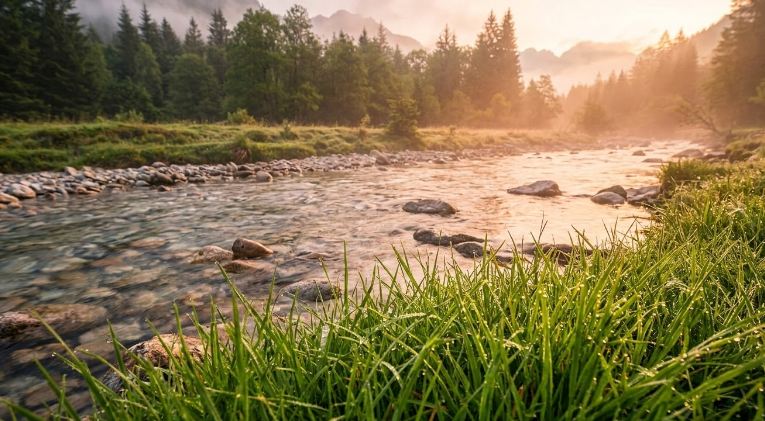
There is a small mountain stream that runs adjacent to my house. Not loud. Not
dramatic. Just clear water moving steadily over smooth stone, carrying what it
carries, going where it goes, making the kind of quiet sound that the mind
stops noticing within a minute and the body never stops needing.
Every morning I sit beside it. Not in ceremony. Not with intention. Simply
because something in me has learned, slowly, that this is the one appointment
of the day I am always glad I kept.
And it is there — not in any office, not in any conversation, not in any
productive or well-scheduled hour — that I meet myself. The version of me
that is not performing. Not catching up. Not managing the distance between
where I am and where I thought I should already be.
Just me. Sitting by water that does not require anything of me. That was
moving before I arrived and will keep moving long after I leave. Water that
is, perhaps, the most patient thing I have ever encountered — and the most
instructive.
Before I could sit by this stream and actually arrive in the sitting, I had
to give something up. Several things, in fact. I had to set down my hurriedness
— the posture of a person always five minutes behind their own life. I had to
release the frustrated grip I kept on things that had not gone to plan. I had
to stop living in the imagined version of the next hour and agree, finally,
to be in this one.
None of that is as simple as it sounds. Some of those things I had been carrying
so long they had stopped feeling like burdens and started feeling like bones —
part of the structure of who I was. Putting them down felt, at first, like
losing myself. Until the stream showed me that what I was losing was never me.
It was only the weight I had agreed to carry in my name.
This post is about that stream. About dewy grass under bare feet. About a
hovering purple sunbird too busy loving a flower to notice it is being observed.
About a newborn calf in the cow shed who looks at you with the kind of eyes that
have not yet learned to be suspicious of the world.
It is about the small, free, daily things that bring us home to ourselves —
and about what we must quietly relinquish before we are able to receive them.
Bare Feet on Wet Grass: What the Body Remembers That the Mind Has Forgotten

There is a particular sensation that belongs entirely to early morning and
to no other hour. The grass in my garden at that time still holds the night’s
dew — cold, present, quietly insisting on being felt. When I walk barefoot
through it, there is a moment of mild shock that is not unpleasant — the body
suddenly reminded that it is not just a vehicle for the mind’s schedules. That
it has its own conversation with the world. That it has, perhaps, been trying
to have that conversation all along, and the shoes simply kept getting in the way.
This is what researchers call grounding, or earthing — the practice of
allowing bare skin to make direct contact with the earth’s surface. Walking on
grass, sitting beside a stream, placing your hands in soil.
WebMD notes that some studies showed people could experience measurable
stress-reduction benefits within as little as 30 minutes of grounding
— and that the earth’s surface carries a negative electrical charge that the
body absorbs on contact, reducing inflammation and calming the nervous system
in ways that have begun to interest mainstream medicine deeply.
But I am less interested, this morning, in the electrons. I am interested in
what the wet grass does to the mind’s idea of itself. Because when the feet
are cold and present and connected to something real, the mind’s performance
of the day ahead becomes briefly, mercifully, irrelevant. The body pulls
attention downward and inward. To the sole of the foot. To the damp ground.
To what is already here, already alive, already not asking you to be anything.
We have written before about the inner wilderness — the quiet internal landscape
that only stillness makes accessible
.
The barefoot morning is one door into it. A wet, cold, entirely free door that
has been available every morning of your life and requires nothing except the
willingness to remove your shoes and step outside before the day has fully
assembled its demands.
My grandmother walked barefoot every morning of her adult life. Not as practice.
Not as wellness ritual. Simply because the ground was there and she knew,
in the way people who live close to the earth know, that contact with it was
not optional for a person who wanted to remain whole. She had no word for
grounding. She had something better: the daily, unquestioned habit of it.
The Mountain Stream and the Mind That Finally Stops Managing
Clear mountain water moves in a way that is almost impossible not to watch.
Not because it is dramatic — it is not. It is simply continuous. Each
moment of it is already becoming the next moment. It does not hold on to the
stone it passed over a second ago. It does not plan the stone it will meet
downstream. It is entirely, uncomplicatedly present in its own movement.
I have spent many mornings watching that stream and thinking — without having
chosen to think it — about what it would mean to live a day with that quality
of motion. Not urgency. Not passivity. Just movement that is fully itself at
every point of its passing.
The science behind what time near natural water does to the human nervous system
is not, at this point, particularly surprising to anyone who has ever sat beside
a river and felt something loosen in the chest.
Harvard Medicine Magazine reported that physicians across the United States are
now formally prescribing time in nature — doses of trails, parks, and green
spaces — as part of treatment plans for grief, depression, and anxiety,
because the objective data behind nature’s effect on the brain has become
impossible to ignore
.
Neurologically, time in natural settings reduces activity in the prefrontal
cortex — specifically the region associated with rumination, self-monitoring,
and the exhausting loop of self-critical thought.
The stream, in other words, is not a passive backdrop to your healing. It is
an active participant in it. The sound of moving water has been shown to engage
the parasympathetic nervous system — the same system that slow nose breathing
activates, the same system that the
five-minute breath reset we wrote about recently
is designed to support. You do not have to meditate beside the stream. You
simply have to let it be louder than your thoughts for long enough that the
thoughts remember their proper size.
And they will. They always do, beside moving water. Because the stream has been
at this much longer than the anxious mind has.
The Purple Sunbird and the Art of Witnessing Something That Doesn’t Need You
Every morning, if I am still enough and patient enough, there is a purple sunbird.
The Purple Sunbird — Cinnyris asiaticus — is small. Impossibly small for
something that carries that much iridescence. The male in breeding plumage is
almost absurdly vivid: a deep, shifting blue-black that catches the light and
becomes purple and then green and then something with no adequate name. He hovers
— briefly, the way only great confidence hovers — beside a flower, and drinks.
And then he is gone. The whole encounter lasts perhaps four seconds. And it is,
without question, one of the most restoring things I witness in any given day.
Not because it is rare. Because it is real. Because it is happening
entirely without reference to me. The sunbird is not performing for my benefit.
He is not aware of my schedule. He has arrived because the flower is open and
he is hungry and the morning is the right temperature and these things align
in a way that has nothing to do with any of my plans or frustrations or delays.
There is a specific quality of relief that comes from witnessing something
beautiful that has no need of your involvement. The world is continuing
without your management. The sunbird does not require your input. The flower
is fine without your opinion of it. You are free, for exactly four seconds,
to be only an observer — which is, paradoxically, the most fully yourself
you can be.
Research from Harvard’s T.H. Chan School of Public Health found that even
brief encounters with nature — as short as 15 minutes for city dwellers —
can produce measurable improvements in mental health
,
and that the researchers who conducted the work reported becoming more curious
about birds and plants they encountered in their daily lives as a direct result.
The noticing itself is restorative. The noticing is the practice.
You do not need to identify the bird. You do not need to photograph it. You need
only to let it be more real to you, for four seconds, than the unread email.
That is the entire instruction. The sunbird will do the rest.
The Newborn Calf and the Eyes That Have Not Yet Learned Suspicion

The cow shed is one of my quieter revelations.
There is something about the smell of a cow shed — warm, hay-sweet, animal-honest —
that strips away a particular kind of pretence faster than almost anything I know.
You cannot be sophisticated in a cow shed. You cannot be performing your best
self. The shed is not interested in your best self. It is interested, faintly
and indifferently, in whether you have brought anything edible.
But the newborn calf is different. The newborn calf looks at you — really looks
at you, with those enormous, amber, absolutely unselfconscious eyes — and there
is in that gaze no judgement, no agenda, no measurement of your worth or adequacy
or recent productivity. The calf looks at you the way the world looked at all of
us before we learned to interpret looking as evaluation.
I stood in the cow shed some weeks ago beside a calf that had been born the night
before. She was still unsteady on her legs. She pressed her forehead against my
hand with a confidence I have not yet managed to feel about my own place in the
world — a simple, animal certainty that contact is safe. That warmth is available.
That the next moment will hold her.
I thought, standing there, about all the things I had been carrying that she
had not yet been asked to pick up. The frustration. The hurriedness. The chronic
low-grade anxiety of being human in a world that moves faster than it means to.
She had not learned any of it yet. And looking at her, I found I could not
entirely justify it in myself.
This is what animals in natural proximity do to the human interior. They expose
the unnecessary weight by being visibly, completely without it.
I have written before about how rest only becomes real when we stop performing
it
— and the cow shed is one of the places where the performance simply cannot
sustain itself. The calf sees through it immediately. Not with wisdom. With
innocence, which is, in some circumstances, a sharper instrument.
What I Had to Set Down Before the Morning Could Hold Me
Hurriedness is not a speed. It is a posture. A way of inhabiting time that treats
each moment as a delay between yourself and somewhere you should already be.
I was a hurried person for years without knowing it — convinced that the urgency
was appropriate to the circumstances, not understanding that I was applying the
same urgency to the kettle and the queue at the chemist and the morning that
I was applying to actual deadlines. Everything received the same level of taut
impatience. Everything felt like it was taking longer than it should.
What hurriedness actually costs is arrival. You cannot be hurried and
present at the same time. They are mutually exclusive states. And if you are
never fully present, then nothing you experience can actually reach you — not
the stream, not the sunbird, not the calf’s forehead against your palm. You are
always already somewhere else, and the things that would have healed you pass
through an empty room.
Unpreparedness was the next thing. Not the unpreparedness of having forgotten
something — but the chronic feeling of incompleteness that follows you regardless
of how prepared you actually are. The sense that you are never quite ready for
your own life. That there is a version of yourself, adequately assembled,
who will show up eventually and handle things properly — and you are merely
filling in until they arrive. I was filling in for myself for a very long time.
Frustration was the most stubborn. Not the acute frustration of a specific bad
day, but the residue of many days accumulated and never fully dissolved —
a kind of background static that coloured everything slightly grey. When I sat
by the stream carrying that frustration, the stream was still beautiful, but
I could not quite get to the beauty. It was like watching something extraordinary
through slightly frosted glass. Present. Visible. Unreachable.
Setting these things down was not a single event. It was a slow, patient,
sometimes backsliding process that the morning routine made possible simply by
requiring me to show up at the stream before the day had a chance to rebuild
the weight. Some mornings the weight was already there when I arrived. The stream
did not mind. It kept moving. And eventually, so did I.
What Nature Heals Without Ever Calling It Healing
Nature’s particular genius is that it never announces itself as medicine.
The stream does not tell you it is reducing your cortisol levels. The sunbird
does not know it is improving your mood. The dewy grass under your feet
does not explain that it is reducing inflammation through electron transfer
and calibrating your parasympathetic nervous system.
It simply does these things, in silence, while you think you are only watching
water move or a bird drink.
Healthline notes that grounding — direct contact with the earth — has been
linked in multiple studies to lower inflammation, improved blood flow, reduced
fatigue, and better nervous system regulation
,
and that its effects can begin within thirty minutes of consistent practice.
Not thirty days. Thirty minutes. The morning you have already been spending
by the stream, it turns out, was working whether you believed in it or not.
But what science is slower to articulate — what requires something more like
literature than research — is the emotional texture of this healing. The way
it comes in sideways. The way you notice, one morning, that the frustration
that was your constant companion last Tuesday is simply not there today. Not
solved. Not addressed. Just quietly absent, the way houseguests sometimes leave
before you wake, taking their noise with them.
Nature heals the way water heals a stone — not by force, not by intention,
but by showing up daily and staying long enough. The stone does not decide
to become smooth. It simply allows the water its passage. And one day you
notice it is smooth.
This is what I mean when I say the stream taught me something the books on
wellness could not quite reach. Not a technique. Not a framework. An
understanding — physical, daily, wordless — that returning to what
is real is not a retreat from life. It is the only way, I have found, to live
one that is worth the living.
Who You Are When the Morning Has Not Yet Told You Who to Be
There is a version of you that exists in the space before the day assembles
its instructions. Before the phone has been checked, before the obligations
have lined up, before the identity you maintain for the world has fully dressed
itself and put on its appropriate expression.
That version of you — the one who simply exists, without agenda, in the morning
quiet — is not your lesser self. It is your oldest self. The one who was
present before the hurriedness was installed. The one who knew, before anyone
told you otherwise, that the stream was worth sitting beside.
I think of the morning ritual — stream, grass, sunbird, cow shed — less as a
practice I have chosen and more as a series of encounters I allow. Encounters
with things that are entirely themselves, which permits me, in their company,
to be entirely myself. You cannot be dishonest beside a mountain stream. Not
because it judges dishonesty. Because it models authenticity so completely
and without effort that pretence simply becomes exhausting by comparison.
The simplest systems are the ones that hold when motivation fails
— and this is the simplest system I know. Not an app. Not a subscription.
A door. Opened daily. Before the world has fully woken up to ask you for things.
The stream will be there. The grass will still be wet. The sunbird will arrive
at the flower whether you watch or not — though it is far better, I find,
to watch.
The Long Conversation Between a Life and Its Mornings
I have been thinking lately about what it means to tend to something daily not
because you can see the result but because you trust the direction. A farmer
does not stand in the field demanding the crop explain itself. They water it.
They come back. They trust the soil to know what to do with the attention.
The morning ritual is like that. You do not always feel its effects on the
day it occurs. Sometimes the frustration returns by mid-morning. Sometimes
the hurriedness is back before lunch. But something is accumulating, slowly,
in the direction of the person you are becoming — a person who knows where
their centre is, who knows how to find it, who has a physical, sensory, daily
practice of returning to it before the world has managed to move them too far
from it.
That person will age well. Not because they will have avoided difficulty — they
will not — but because they will have built, through a thousand quiet mornings,
the interior architecture that difficulty requires.
Living long and living well are not the same thing, as we wrote in our piece
on emotional wellbeing and the long life
— but both are built in the ordinary moments, the unremarkable mornings,
the daily choice to sit by the water before the water becomes a metaphor you
no longer have time to visit.
Go to the stream. Go today. Take off your shoes.
Everything that needs to happen next will still be there when you return.
And you will be better equipped to meet it — not because the stream will have
solved anything, but because you will have remembered, again, who you are
when nothing is demanding you be anyone.
A Letter to the Morning You Have Not Yet Allowed Yourself
There is a stream near your house, or a park, or a patch of grass, or a single
tree that has been growing patiently at the end of your road. There is a bird —
possibly a sunbird, possibly a sparrow, possibly something whose name you do not
know and do not need to know — that arrives at the same flower at roughly the
same time each morning and is entirely, gloriously indifferent to your awareness
of it.
There is a morning available to you that does not begin with a screen. That begins
instead with wet grass and open air and the sound of something moving that is
not being moved by deadlines. That morning has been waiting for you, patiently,
in the way good things wait — without resentment, without urgency, without any
particular need for you to arrive but with everything to offer when you do.
What you will need to set down to get there is real. The hurriedness is real.
The unpreparedness is real. The frustration and the delay and the accumulated
weight of being a person in a fast world — all of it is real, and none of it
is permanent, and not one single piece of it will follow you into the stream’s
quiet the way it follows you through every other hour of the day.
The stream does not carry your history. It does not know your shortcomings. It
moves and is clear and asks nothing of you except that you sit beside it long
enough to remember that you, too, once knew how to simply be.
You still do. You have not forgotten. You have only been too busy to
remember.
Tomorrow morning. Earlier than you think you have time for. Before the
world assembles its demands. The stream will be there.
So will you — if you let yourself.
Questions the Morning Quietly Asks (and Answers)
Why does nature make us feel more like ourselves?
Nature slows the nervous system and removes the demand to perform. When the
stream is moving and the birds are present, the mind stops managing its image
and starts simply perceiving.
Harvard Medicine has reported that physicians are now formally prescribing
structured time in nature for depression and anxiety
— because the evidence for its calming, restorative effects on brain function
is no longer soft. You feel like yourself in nature because nature is the
only environment that does not ask you to be anyone other than what you
already are.
What is earthing or grounding and does it actually work?
Grounding — also called earthing — means allowing your bare skin, usually your
feet, to make direct contact with the earth’s surface. Walking barefoot on
dewy grass, sitting beside a stream, placing your hands in soil are all
forms of it.
WebMD notes that some studies showed measurable stress-reduction benefits
within as little as 30 minutes
— and research published in peer-reviewed journals suggests it reduces
inflammation and improves nervous system regulation. The barefoot morning
walk is not folklore. The body knows the earth.
What is a Purple Sunbird and why does it matter for wellbeing?
The Purple Sunbird (Cinnyris asiaticus) is a small, iridescent,
nectar-feeding bird native to the Indian subcontinent. It hovers briefly
beside flowers — hummingbird-style — and drinks. It is impossibly quick
and entirely unconcerned with you. Birdsong and wildlife encounters have
been shown in research to improve mood and reduce mental fatigue. The sunbird
at the flower is not a distraction from your morning. It is an invitation
into it.
What did I have to give up to feel at home in myself?
Hurriedness. Unpreparedness that masquerades as busyness. Frustration held
so long it stopped feeling like frustration and started feeling like
personality. The habit of delay — of living slightly ahead of where you
actually are, in the imagined next moment. These are not small things to
release. But they are not permanent fixtures either. They are postures.
And postures, held long enough, can be gently, slowly, set down.
How do I come home to myself through nature if I live in a city?
Research from Harvard’s T.H. Chan School of Public Health found that even
15 minutes of contact with urban nature can improve mental health measurably
for city dwellers
.
You do not need a mountain stream outside your door. You need five minutes
barefoot on whatever ground is available and the willingness to look at what
is already there before you fill the silence with what is next.
What you put down in the evening shapes what you wake into in the morning
— and what you allow in the morning shapes everything that follows.
Medical Disclaimer: The information provided on this blog is for educational and informational purposes only and is not intended as medical advice. While I share insights on wellness and mindfulness, I am not a medical professional. Always seek the advice of your physician or other qualified health providers with any questions you may have regarding a medical condition. Never disregard professional medical advice or delay in seeking it because of something you have read on this website.


Please Leave a Reply